Please install Flash® and turn on Javascript.
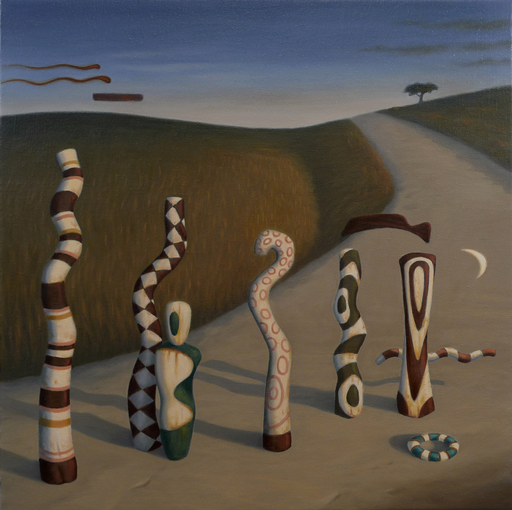
The "constructive melancholy" that sometimes appears as peace in these works is usually deceptive and on the edge of some tension or turbulence which is about to overwhelm the stage-set.
Symbolist works stem from a state of mind which rummages around at the peripheries of 'real consciousness and perception',that area which is the terrain of mythology, personal and collective. Symbolism has always been there in art from the beginning.
The questions that recur in my works such as ,What is mythology ?, What is history ?, How far do they overlap?, and, In how far are they trapped in a clock-work of repetition ?;.. make me also consider these loosely as metaphysical works.
File under,.." Metaphysical Humanism ",...if inclined to filing,.. I find it a fair enough description.
Dreaming consciousness is an ocean within which waking life is a rockpool at low-tide.
Occasionally I've thought that this small fairy tale extract from 'The Magus'by John Fowles is a better artist's statement than anything I can put together.
THE PRINCE AND THE MAGICIAN
Once upon a time there was a young prince, who believed in all things but three. He did not believe in princesses, he did not believe in islands, he did not believe in God. His father, the King, told him that such things did not exist. As there were no princesses or islands in his father's domaines, and no sign of God, the young prince believed his father.
But then, one day, the prince ran away from his palace. He came to the next land. There, to his astonishment, from every coast he saw islands, and on these islands, strange and troubling creatures whom he dared not name. As he was searching for a boat, a man in full evening dress approached him along the shore.
'Are those real islands?' asked the young prince.
'Of course they are real islands,' said the man in evening dress.
'And those strange and troubling creatures?'
'They are all genuine and authentic princesses.'
'Then God must also exist!' cried the prince.
'I am God,' replied the man in full evening dress, with a bow.
The young prince returned home as quickly as he could.
'So you are back,' said his father, the King.
'I have seen islands, I have seen princesses, I have seen God,' said the prince reproachfully.
The king was unmoved.
'Neither real islands, nor real princesses, nor a real God, exist.'
'I saw them!'
'Tell me how God was dressed.'
'God was in full evening dress.'
'Were the sleeves of his coat rolled back?'
The prince remembered that they had been. The king smiled.
'That is the uniform of a magician. You have been deceived.'
At this, the prince returned to the next land, and went to the same shore, where he once again came upon the man in full evening dress.
'My father the king has told me who you are,' said the young prince indignantly. 'You deceived me last time, but not again. Now I know that those are not real islands and real princesses, because you are a magician.'
The man on the shore smiled.
'It is you who are deceived, my boy. In your father's kingdom there are many islands and many princesses. But you are under your father's spell, so you cannot see them.'
The prince returned pensively home. When he saw his father, he looked him in the eyes.
'Father, is it true that you are not a real king, but only a magician?'
The king smiled, and rolled back his sleeves.
'Yes, my son, I am only a magician.'
'Then the man on the shore was God.'
'The man on the shore was another magician.'
'I must know the real truth, the truth beyond magic.'
'There is no truth beyond magic,' said the king.
The prince was full of sadness.
He said, 'I will kill myself.'
The king by magic caused death to appear. Death stood in the door and beckoned to the prince. The prince shuddered. He remembered the beautiful but unreal islands and the unreal but beautiful princesses.
'Very well,' he said. 'I can bear it.'
'You see, my son,' said the king, 'you too now begin to become a magician.'
-- From 'The Magus' by John Fowles